
Making Membal – Design and Characters
- 1 day ago
- 5 min read

Membal is the latest video game I’ve released. It’s a small adventure where, while building your own village, you train your memory through mini-games. You can find more information and links to digital stores on the official Membal website.
This game was one of the very first ideas I ever had related to creating video games. When I was sixteen, my aunt was diagnosed with Alzheimer’s, and I wanted to help her by creating an app to train memory in a fun way. It was innocent and naïve, but I tried to make the game a reality. At the time, I had absolutely no programming knowledge, but I did know how to use Photoshop, so I started by creating the art. Eventually, I gave up, but I’m still surprised by how far I got.
About two years ago, my aunt passed away. Shortly after that, I remembered this old project, Membal. I decided I had to make it, for myself and for her. It was one of the ideas that pushed me toward creating my own games, so I didn’t want to leave it abandoned. It’s also a tribute to her, and perhaps a small hope that it might help others in a similar situation.
In this post, I’ll talk about the creation of this video game. I’ll focus mainly on design and art rather than programming, marketing, or distribution. I don’t recommend reading this if you haven’t played the game, as it will contain spoilers. From here on, I’ll go through each section of the game and compare it to the original idea. I’ll also compare the old art with the new, since I adapted everything I created as a teenager into a more current and personal style. Even so, I tried to stay faithful to the original art without making too many changes.
Name, Logo, and Inspirations:
The name Membal comes from “Memory” + “Animal,” which perfectly summarizes the game. The “b” in Membal has no special meaning beyond making the syllables flow better.
The original Membal logo looked like this:


I started adapting it into a modern version, but I wasn’t convinced by the idea of the “e” shaped like a brain. After thinking it through, the final result was keeping the wooden sign and adding a meaningful icon from the game: an animal footprint with a brain.

For promotion, I wanted to recreate the original image with an updated style. The result was this:

I wasn’t fully convinced, so I made another iteration. Even so, I like to reuse everything I create, so that version appears in the game as a phone wallpaper.
Illustration isn’t my strongest skill, but I wanted to try making something eye-catching and professional. I’m quite happy with the result. It’s easy to adapt to different sizes, which is why it became the main promotional image and also appears as the first loading screen in the game.



The app icon was also designed when I was a teenager. I didn’t like it anymore, so I decided to make it consistent with the logo. Now it’s simply the wooden footprint with a brain.


The main inspirations behind the game were Animal Crossing, Zelda, and Pokémon. These were the games I had in mind as a teenager. Pokémon’s Game Boy style was especially present. The idea of a village with animals you could interact with and build relationships with came from Animal Crossing and Zelda. Originally, moving around Membal involved unlocking tools and completing more RPG-like missions.
However, when I revisited the idea years later, I didn’t have specific references in mind. Many mechanics were simplified. I reduced the importance of relationships with villagers, made the game less RPG-focused, and aimed for a more personal art style. I centered the experience more on memory training and village building and decoration. Looking back, my original concept was a bit of a Frankenstein, and studying and working on games for over five years helped me realize that.
General Design
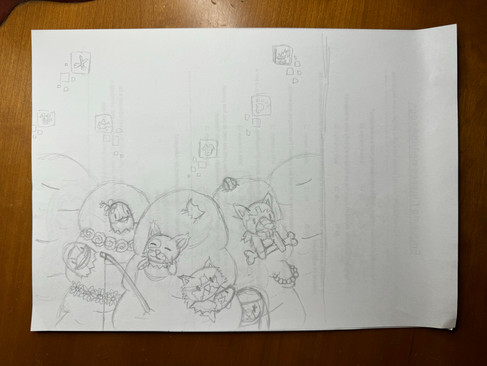
These were the first design documents for Membal. Initially, you had an ID card that stored your information and allowed you to access mini-games. From there, you could press an “adventure mode” button to move around the village. You can also see early mini-game ideas and icons that I either kept or modified.




These are the current “documents.” I still use paper to develop my ideas, both for design and art. I even used this notebook for programming. It may look chaotic, but it contains everything I needed to create Membal.





Characters
From the beginning, I knew there would be 10 guilds, each with 12 animals you could invite to the village. Each animal would have a mission you needed to complete. In the original document, I first defined the guilds and noted different types of animals for each one. Then I started drawing them in a very organized way. Each page contained all animals from one guild, including price, rewards, and extra notes about missions.










Originally, you were supposed to choose one villager as your personal memory trainer, which meant each had a lot more dialogue. Looking back, some of it makes me cringe, so I’ll just show a small portion. Each page was dedicated to one character, with dialogue for after finishing mini-games and for village interactions. Many dialogue options changed depending on conditions and character relationships. Some of this remains, but I simplified it to one normal line and one special line.

Now we move on to the art I created when I was sixteen. For some of my first work, it wasn’t bad. Still, I decided to redo everything in what I called the “kawaiification” process.


And here’s the result after “kawaiification.” Yes, I removed their arms. They fit better inside menus this way. I did something similar in TacTac Prologue, so it’s become a habit.





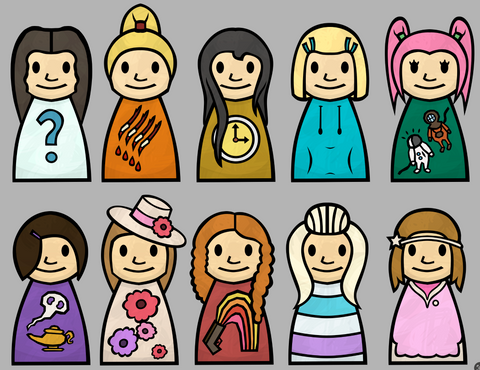
The main character, hairstyles, and outfits were also designed from the start.



Of course, they were also “kawaiified.” I added two new appearances: Hei and gold skin.



As for special characters, these were created more recently to fulfill certain game needs. Besides my aunt, I added pets like my cat Miso, my sister’s cat Kali, and my other sister’s cat Floki. Fu and Fa, two cats that appear in all my games, are there too, along with the hedgehog from the Goca Games logo. Characters from other games also appear, like Mochi (transformed into an animal), Asquita, and Pingui. As a fun fact, Mox was born from a mistake I made while designing his brother Xom.
Finally, there are five event characters: Muteen, Satru, Camor, Rodolfo, and Pasquito. They appear on specific dates and represent different festivities. I thought adding temporary characters would make the universe feel more alive and keep players curious, in true Animal Crossing fashion.


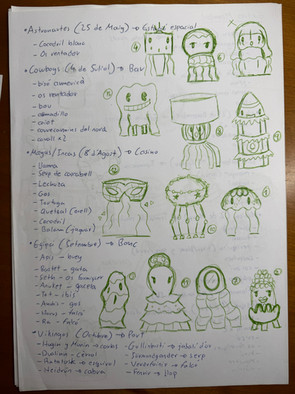
Near the end of development, I felt something was missing. I wanted a kind of post-game to motivate players to continue practicing memory after finishing the main story. That’s why the Jellies from Jellyfishers make a special appearance as the final guild to unlock. Does that mean something more? Who knows…


And that’s it for today’s post about the development of Membal. If I feel like it, I’ll continue with other aspects such as village design, objects, programming, and more.

Comments